Church of the SS. Crocifisso di Brongo
Centrally planned church
Renaissance / Mannerist
1573–1613
Placido Buffelli created both the southern portal and the wooden statue of the dying Christ, as well as the high altar. Beside the church stood a small Franciscan hospice, whose friars were expelled in 1632 under the influence of the Dominican Fathers.
Indeed, the church stands in the area of the ancient hamlet of Brongo (casale di Brongo), one of the villages that populated the territory before the formation of Borgo Terra. Today, that village no longer exists, but its memory lives on in this place, immersed in the greenery of the current Park of the SS. Crocifisso. Here, the memory of the medieval landscape meets spirituality, and the stones of the church seem to guard the memory of a community that has vanished but is not forgotten. The building we see today was constructed between 1573 and 1613 by order of Cornelia de Monti, widow of Prince Giovanni Battista I Protonobilissimo. The choice of location was not accidental. The new church rose upon the remains of a previous Greek-rite building, likely the ancient church of the medieval hamlet of Brongo itself. Once again, as happens in many places in Salento, one history does not erase the previous one, but layers over it, transforming it while preserving its traces.
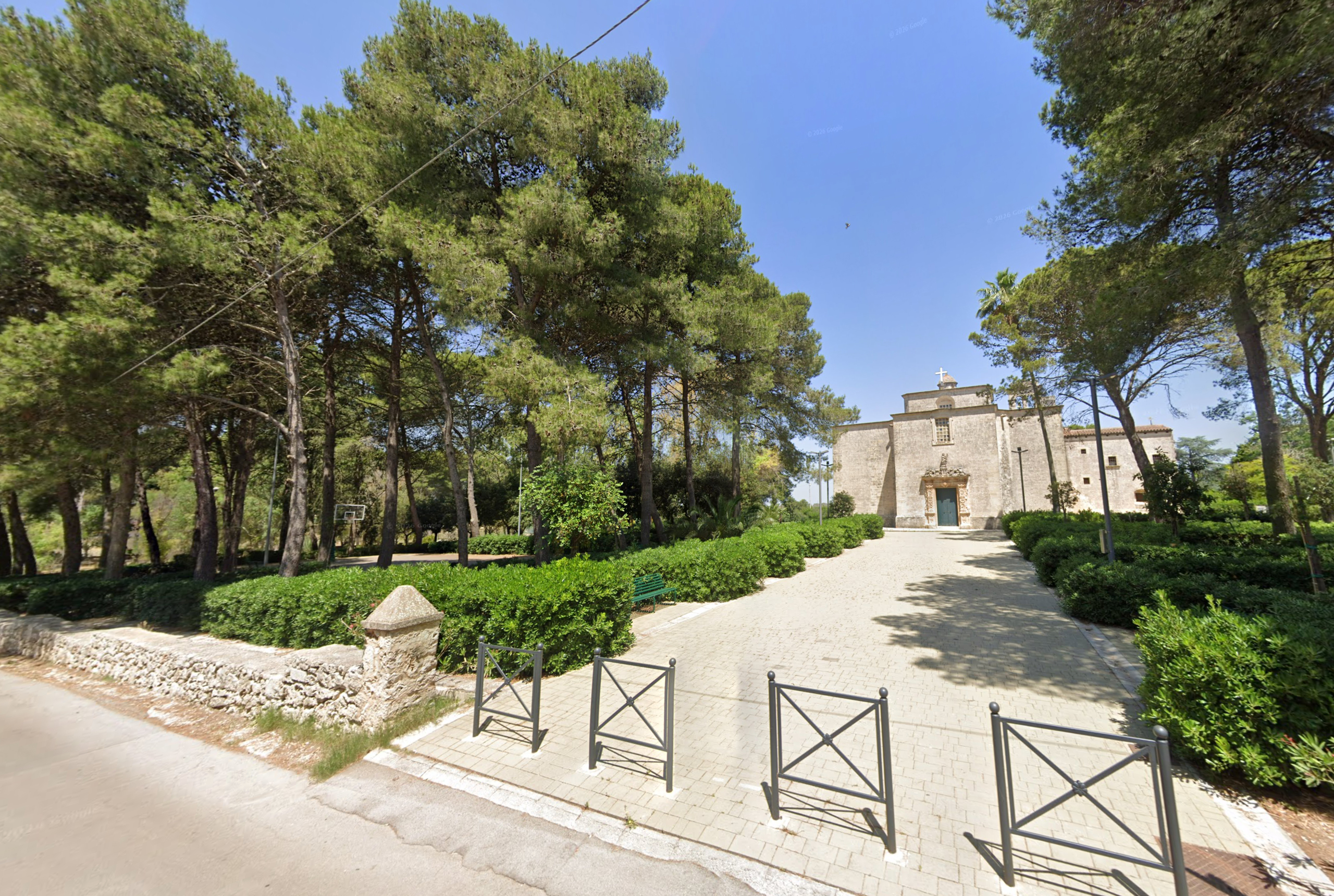
Its Greek cross plan, surmounted by a dome positioned at the intersection of the arms, echoes forms rooted in Byzantine and Mediterranean traditions. It is a balanced, intimate structure built to foster a close relationship between space and spirituality.
Even from the outside, the building reveals some highly interesting details. Between the two entrances, the southern one stands as one of the most refined elements of the entire complex. Built in 1664 and attributed to the sculptor Placido Buffelli, it stands out for its carved panels combining religious motifs and mythological figures. It is a portal that surprises with its symbolic richness, testifying to the extraordinary skill of Salentine artists in working with stone as if it were a precious fabric. Stepping inside, you are welcomed by an intimate and intense atmosphere. At the centre of devotion sits the wooden statue of the Dying Christ (Cristo Morente), also a work by Placido Buffelli. The figure is striking for its expressive intensity and its capacity to translate pain, suffering, and the humanity of the Passion into wood. Alongside it, the high altar is preserved, crafted by the same artist, which helps define the unified character of the sacred space.
To the sides are two altars commissioned by the barons of Muro: one dedicated to Santa Maria della Pietà (Saint Mary of Mercy), the other to St. John the Baptist. These are testimony to the devotion of local aristocratic families who, through art and patronage, helped shape the religious identity of the land. But the history of the Crocifisso di Brongo does not speak only of architecture and spirituality. It also recounts the sometimes turbulent dynamics that rippled through the town's religious life.
Alongside the church, a small hospice was built to house the Franciscan friars. Their presence in Muro Leccese was, however, brief and troubled. In the early decades of the seventeenth century, the coexistence of Franciscans and Dominicans appears to have been marked by tension and rivalry. Local chronicles record that, following the death of Francesco Protonobilissimo, regarded as the protector of the Franciscans, the friars were expelled from the town at the instigation of Prince Desiderio, acting under the influence of the Dominican Order. These are episodes that may seem distant today, yet they offer a vivid glimpse into the society of the time. Behind the grand architecture and the monuments, there were real people with competing interests, differing religious sensibilities and sometimes open conflict. The history of Muro Leccese is not made of harmony alone but also of confrontations and rivalries that helped shape its identity.
Perhaps this is precisely what makes the Church of the Santissimo Crocifisso so fascinating: it is not simply a religious building set amid greenery. It is a place of thresholds. A threshold between the town and the countryside, between the world of the medieval hamlets and that of the modern town, between Byzantine tradition and post-Tridentine culture, between the memory of the Franciscans and that of the Dominicans.